Pearson Edexcel · GCSE · History
Course version: 1HI0 · Version from Sept 2016
C1500–c1700: Crime and punishment in early modern England - 1 Nature and…
Full specification wording
Option 10: c1500–c1700: Crime and punishment in early modern England - 1 Nature and changing definitions of criminal activity: Continuity and change in the nature of crimes against the person, property and authority, including heresy and treason.
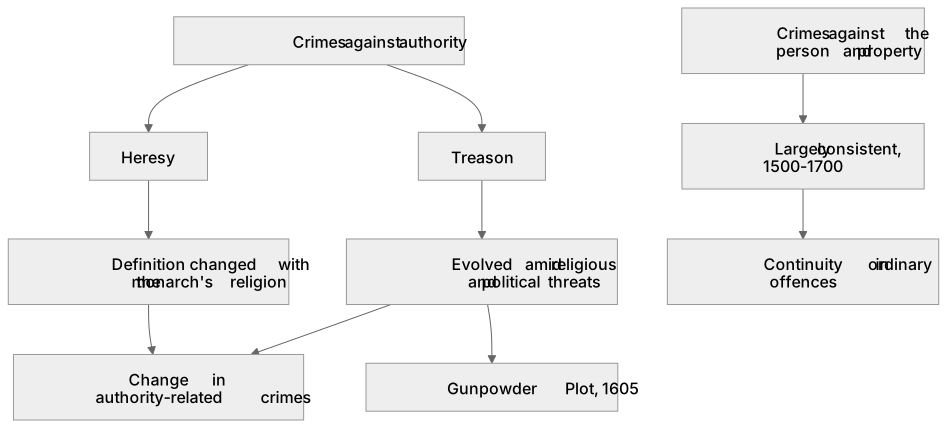
Between 1500 and 1700, crimes against the person (like murder) and property (like theft) remained largely consistent, reflecting continuity in everyday criminal activity.
Checked against the Pearson Edexcel 1HI0 specification (opens in a new tab) on .
- Point 1 of 2
- 4 key terms
Study notes
From the checked teaching notes for this specification point.
The idea
Between 1500 and 1700, crimes against the person (like murder) and property (like theft) remained largely consistent, reflecting continuity in everyday criminal activity. However, crimes against authority saw significant changes due to religious and political turmoil. The English Reformation meant that heresy (holding beliefs contrary to the monarch's religion) became a prominent crime, with definitions changing depending on the monarch's faith. Treason also evolved, particularly following events like the Gunpowder Plot (1605), as monarchs sought to protect their power against religious and political threats.
What earns the marks
- Identify continuity in crimes against the person and property, such as murder, assault, and petty theft.
- Explain how the definition of heresy changed depending on the religious views of the reigning monarch, such as the shift from Mary I to Elizabeth I.
- Describe the changing nature of treason, linking it to political instability and religious conflict, such as the Gunpowder Plot.
- Analyse the relationship between crimes against authority and the monarch's need to maintain control during periods of religious upheaval.
Common mistakes and how to put them right
Confusing heresy and treason.
Put it right: Heresy is a crime against the Church or religion, whereas treason is a crime against the monarch or state, though they often overlapped in this period.
Assuming all crimes changed significantly.
Put it right: Everyday crimes against the person and property remained largely the same as in the medieval period.
Believing heresy was a new crime in this period.
Put it right: It existed previously but became much more prominent and volatile due to the Reformation.
Exam tips
- Use specific monarchs, such as Mary I for Catholic heresy executions, to illustrate how definitions of crimes against authority changed.
- When asked about change, always acknowledge what stayed the same to provide a balanced and comprehensive answer.
- Link the increase in treason charges to specific historical events, such as the Gunpowder Plot or the English Civil War.
Try the lesson
The start of the Option 10: c1500–c1700: Crime and punishment in early modern England - 1 Nature and changing definitions of criminal activity: Continuity and change in the nature of crimes against the person, property and authority, including heresy and treason. lesson, made from checked teaching notes for this specification point.
Have a go first
Which of the following best describes the crime of heresy in early modern England?
Listen
Between 1500 and 1700, crimes against the person (like murder) and property (like theft) remained largely consistent, reflecting continuity in everyday criminal activity. However, crimes against authority saw significant changes due to religious and political turmoil. The English Reformation meant that heresy (holding beliefs contrary to the monarch's religion) became a prominent crime, with definitions changing depending on the monarch's faith. Treason also evolved, particularly following events like the Gunpowder Plot (1605), as monarchs sought to protect their power against religious and political threats. A strong answer earns marks for these points. Identify continuity in crimes against the person and property, such as murder, assault, and petty theft. Explain how the definition of heresy changed depending on the religious views of the reigning monarch, such as the shift from Mary I to Elizabeth I. Describe the changing nature of treason, linking it to political instability and religious conflict, such as the Gunpowder Plot. Analyse the relationship between crimes against authority and the monarch's need to maintain control during periods of religious upheaval. Exam tip: Use specific monarchs, such as Mary I for Catholic heresy executions, to illustrate how definitions of crimes against authority changed.
See it
Key words
Say what each word means before you turn the card.
Continuity and change
Try answering aloud or in your head before turning the card.
Heresy
Try answering aloud or in your head before turning the card.
Treason
Try answering aloud or in your head before turning the card.
Crimes against authority
Try answering aloud or in your head before turning the card.
See every definition
- Continuity and change
- The pattern in which crimes against the person and property remained largely consistent while crimes against authority saw significant changes.
- Heresy
- Holding beliefs contrary to the monarch's religion, a crime whose definition changed depending on the monarch's faith.
- Treason
- A crime against the monarch or state that evolved as monarchs sought to protect their power against religious and political threats.
- Crimes against authority
- Offences such as heresy and treason that changed due to religious and political turmoil, in contrast with the continuity of ordinary offences.
Label the diagram
Some boxes have lost their names. Pick the right name for each number.
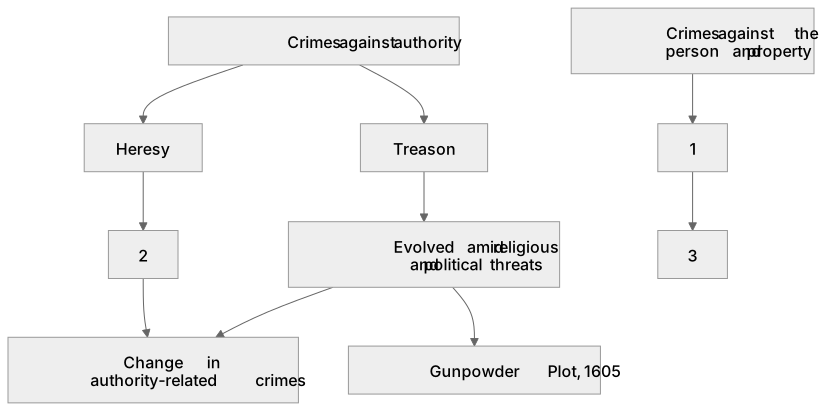
1Box 1
2Box 2
3Box 3
There is more to this lesson
The full lesson goes on to check your understanding and help you earn the marks. Create a free account to carry on, with your progress saved.
A week of Premium from your first lesson · Then the free plan continues · No card, no charge
Test your understanding of Option 10: c1500–c1700: Crime and punishment in early modern England - 1 Nature and changing definitions of criminal activity: Continuity and change in the nature of crimes against the person, property and authority, including heresy and treason.
Active recall beats re-reading. Take an instant quiz now to test what you’ve learned and lock it into long-term memory.
A week of Premium from your first lesson · Then the free plan continues · No card, no charge